


I’ve been teaching in Further Education for over twenty years. Long enough to watch ideas arrive with confidence. Solidify into policy. Get embedded. Then fade out. Only to resurface years later, rebranded, apparently refreshed, and oddly untouched by what happened in between.
Learning styles are the most stubborn example I have seen.
When I started out, differentiation was the dominant language. Then came Every Child Matters, with its necessary focus on fairness and access. Somewhere along the way, though, that concern for inclusion seems to have shifted. It stopped being something that emerged through teaching and became something you demonstrated through documentation.
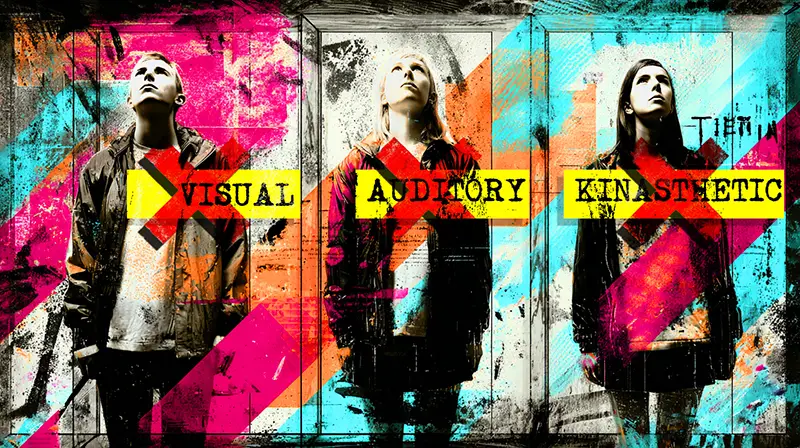
By the time learning styles took hold, many of us were starting the year not by teaching and observing students, but by handing out VAK or VARK questionnaires. The results went straight into group profiles, lesson plans, and lesson visit paperwork.
- Visual
- Auditory
- Kinaesthetic
As if people could be organised that cleanly.
I remember feeling uneasy early on. Not because inclusion was not important to me. Quite the opposite. It was because this version of it felt thin. Too neat and tidy. Students were reduced to labels and teaching started to resemble a matching exercise.
Over time, research appeared to support that discomfort. The core claims behind learning styles were tested properly and they did not hold up.
The evidence moved on. The practice stayed put.
Learning styles still surface in meetings. They still appear in training sessions, often delivered with complete confidence. I recently completed a SEND in education qualification that included a full section on learning styles, presented without critique, as though the past fifteen years of research had never happened.
That should make us stop and think.
Learning styles do not just fail to improve learning. They reshape what inclusive teaching comes to mean in FE. Slowly. Subtly. In ways that feel reasonable and professionally safe.
Which helps explain their staying power.
Why Learning Styles Became Embedded in Further Education
If learning styles were simply a misunderstanding of research, they would probably have disappeared years ago.
They did not.
And that matters.
They didn’t spread through FE because teachers were naïve or uninterested in evidence. They spread because they solved several institutional problems at once.
Further Education serves students with very different experiences of schooling. Many arrive already carrying labels such as low ability, disengaged, or not academic. At the same time, staff work in systems that demand visible proof of inclusion, responsiveness, and individualisation.
Learning styles fitted that context almost perfectly.
They offered a shared language for difference. They turned variation into something teachable, describable, and easy to record. You could reference them in planning. Point to them during lesson visits. Include them in audits. They sat comfortably in a culture that often values evidence of practice over what that practice actually achieves.
This is also why group profiles became such an important artefact. When written well, they can genuinely help teachers think about prior knowledge, confidence, and starting points. When they lean on labels like learning styles, they do the opposite. I have written more about how to approach this properly here:
https://thedigitalconsultant.co.uk/how-to-write-student-group-profiles/
Learning styles also felt humane.
Telling a student they are a visual or kinaesthetic learner sounds affirming. It reframes difficulty as difference rather than failure. For educators committed to widening participation, that framing feels aligned with the job.
There were practical reasons too.
Post sixteen education runs on compressed CPD, heavy timetables, and constant accountability. Simple frameworks spread quickly. Nuance struggles to travel. Learning styles could be explained in one session, applied immediately, and recognised by managers.
Once embedded, they sustained themselves.
Planning templates asked how learning styles would be addressed. Lesson visit criteria rewarded visible matching of activity to style. Group profiles described cohorts as practical, visual, or discussion based. Over time, learning styles stopped being a theory and became part of the infrastructure.
At that point, belief barely mattered.
Even staff who doubted learning styles often continued to use the language because it was familiar, accepted, and safe. It signalled care. It signalled inclusion. It avoided awkward conversations.
Which is why sharing research, on its own, rarely changes practice.
Learning styles lasted not because they were right, but because they stood in for things educators genuinely value. Respect for learners as individuals. A rejection of one size fits all teaching. A desire to do the right thing.
If we want to move on, we need to be honest about what learning styles were doing for us, and why they now get in the way.
Preference, Performance, and How Inclusion Gets Bent
One reason learning styles still feel defensible is that they rest on a mistake that sounds sensible at first glance.
They treat preference, engagement, and learning as if they all point in the same direction.
They don’t.
Students in FE are usually very clear about what they like. Some say they prefer videos. Some say they hate reading. Some want to get straight to the practical work and avoid theory altogether. These preferences are real. They matter. They tell us something. They just don’t tell us what helps students learn best!
A student preferring diagrams doesn’t mean diagrams are the most effective route to understanding. Enjoying discussion doesn’t guarantee secure knowledge. Avoiding reading doesn’t mean reading is inaccessible or unnecessary.
Preference tells us what feels comfortable.
It tells us very little about what builds capability.
Inclusive teaching should be justified by what helps students learn more over time, not by what produces the least resistance in the moment.
Engagement Is a Weak Proxy for Learning
In FE, this often shows up in decisions that look caring on the surface.
Theory inputs get shortened because students say they lose focus. Explanations are trimmed because students describe themselves as practical. Reading is reduced because students report disengagement.
Each decision makes sense on its own.
Taken together, they lower what students are expected to cope with.
Engagement hides this drift.
Engagement is visible. Learning isn’t.
Students often look more engaged when teaching aligns with what they say they prefer. Behaviour improves. Participation increases. Feedback sounds positive.
But engagement and learning are not the same thing.
Students can enjoy activities that lead to very little lasting learning. They can also struggle through tasks that feel uncomfortable while learning a great deal.
When engagement becomes the main signal of success, teaching drifts towards what feels good rather than what develops understanding, and it matters because many FE courses involve unavoidable forms of thinking.
Students must read specifications, follow spoken instructions, interpret diagrams, write extended responses, and apply abstract rules under pressure. These demands are part of the curriculum.
When teaching is adjusted to avoid those demands rather than support students through them, inclusion starts to look like protection from challenge.
When Preference Becomes Identity
Learning styles accelerate this shift by turning preference into identity.
Once a student is described as a visual, auditory, or kinaesthetic learner, avoidance starts to look like accommodation. Reduced exposure is framed as support. Difficulty is explained as mismatch rather than something teaching can respond to.
This is not about a lack of care. It’s about bad categories doing real harm.
The key question for inclusive teaching is not what students say they prefer. It’s what the curriculum requires them to be able to do, and how teaching can help them get there.
Learning styles answer the wrong question with confidence. That confidence has kept them alive.
What This Looks Like in Practice
You can see the effects clearly in everyday FE settings.
In construction, students are often described as practical. They are labelled kinaesthetic. Theory inputs get shorter. Reading gets reduced. Demonstration replaces explanation.
The qualification still demands engagement with regulations and written assessment. Reduced exposure doesn’t remove those demands. It just delays the moment students have to face them.
In health and social care, students may be described as auditory learners because they enjoy discussion and role play. Reading and written analysis are softened. Engagement improves. Preparedness often does not.
In creative subjects, visual preference can steer students away from evaluation and extended writing, even when assessment criteria require both.
Once these assumptions appear in group profiles, expectations are set before teaching even begins.
Where Adaptive Teaching Actually Fits
Rejecting learning styles doesn’t mean rejecting responsiveness. It means being clearer about what you are responding to.
Adaptive teaching starts with the curriculum, not the learner label. The destination stays fixed. What varies is the support, the sequencing, and the way misconceptions are addressed as they appear. I have written about this distinction, and why it matters more than the language of differentiation, here:
https://thedigitalconsultant.co.uk/adaptive-teaching-vs-differentiation/
This approach keeps professional judgement alive. It asks what students need next, not what category they fit into.
Where This Leaves Inclusive Teaching
If learning styles still shape how you plan, support, or explain learner difference, the most useful step is to stop outsourcing professional judgement to frameworks that promise inclusion without evidence.
- Ask yourself where preference is being treated as explanation.
- Where reduced exposure is framed as support.
- Where assumptions shape expectations before teaching starts.
Then replace those habits with something sturdier.
Plan around content, not categories. Adapt teaching based on evidence of learning, not identity. Treat difficulty as something to support through, not something to avoid.
Inclusive teaching does not begin with labels. It begins with the belief that students can do more, and the responsibility to help them get there is ours.
Want the Research? Start With These Evidence-Based Resources
Kirschner, P.A., 2017. Stop propagating the learning styles myth. Computers & Education, 106, pp.166–171. doi:10.1016/j.compedu.2016.12.006 – https://www.sciencedirect.com/science/article/abs/pii/S0360131516302482
Newton, P.M., 2015. The Learning Styles Myth is Thriving in Higher Education. Frontiers in Psychology, 6:1908. doi:10.3389/fpsyg.2015.01908 https://www.frontiersin.org/journals/psychology/articles/10.3389/fpsyg.2015.01908/full
Pashler, H., McDaniel, M., Rohrer, D., & Bjork, R. (2008). Learning styles: Concepts and evidence. Psychological science in the public interest, 9(3), 105-119. https://www.researchgate.net/publication/233600402_Learning_Styles_Concepts_and_Evidence
Willingham, D. T., Hughes, E. M., & Dobolyi, D. G. (2015). The scientific status of learning styles theories. Teaching of Psychology, 42(3), 266-271. https://www.researchgate.net/publication/278666610_The_Scientific_Status_of_Learning_Styles_Theories
Riener, C., & Willingham, D. (2010). The myth of learning styles. Change: The magazine of higher learning, 42(5), 32-35. https://www.researchgate.net/publication/249039450_The_Myth_of_Learning_Styles